Author

Antonina Smyrnova
Today’s teams rely on a wide range of tools, such as CRMs, project management software, databases, marketing platforms, and internal systems. While each tool is effective by itself, problems can occur when data becomes scattered, duplicated, or out of date.
That’s why data syncing tools have become so important. In this guide, we’ll review the best options for syncing data between apps, starting with resynced.io and then covering other popular choices.
Top Tool We Recommend in 2026

1. resynced.io
Before looking at general automation and integration platforms, let’s highlight a tool made specifically for syncing data, rather than just triggering actions.

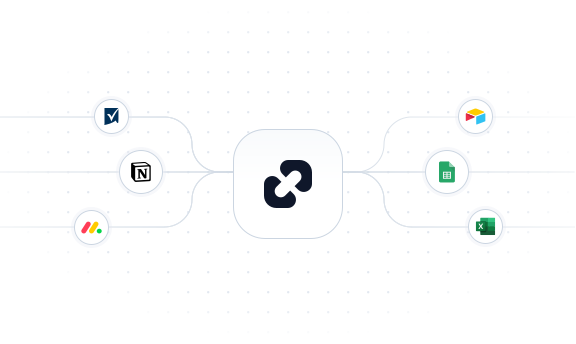
resynced.io is designed to keep data consistent, accurate, and up to date across systems, without relying on fragile workflows or needing constant manual fixes.
Best for:
- Two-way data sync
- CRMs, project management tools, and databases
- Teams working with structured, relational data
- Scaling syncs without increasing maintenance
Key advantages:
- True two-way synchronization
- Flexible field mapping and data control
- Designed for large datasets and long-term reliability
- No-code setup with advanced configuration options
- Sync-first architecture instead of event-based automation
If your top priorities are data integrity and long-term consistency, resynced.io is made for you.

2. Zapier
Many teams start using Zapier for integration. It’s popular and easy to get started, especially for simple automations.

However, Zapier isn’t meant to be a full data synchronization solution.
Best for:
- Simple, one-direction workflows
- Trigger-based automations
- Notifications and task creation
Limitations for syncing:
- No true bi-directional sync
- Not designed for ongoing data consistency
- Becomes fragile with large or frequently updated datasets
Zapier can work alongside a syncing tool, but it’s not reliable for keeping your main data in sync.
Read more about Zapier alternatives in our blog.

3. n8n
Teams with strong technical skills might like open-source platforms like n8n because they offer flexibility and control.

But this flexibility can also make things more complicated and harder to manage.
Best for:
- Developer-led teams
- Custom, self-hosted environments
- API-heavy integrations
Limitations:
- Requires technical expertise to set up and maintain
- Sync logic must be built manually
- No built-in focus on data synchronization
n8n works well for custom engineering projects, but it’s rarely the fastest way to get reliable syncing.

4. Tray.io
Tray.io is a low-code integration platform aimed at advanced needs. It provides strong API features and flexibility for enterprises.

However, many teams don’t need this level of complexity for basic data syncing.
Best for:
- Technical operations teams
- Complex API-based integrations
- Larger organisations with integration specialists
Limitations:
- Steep learning curve
- Higher cost
- Sync logic requires careful design and ongoing monitoring
Tray.io is powerful, but it’s often more than you need just to keep your data clean and in sync.

5. Workato
Large enterprises often choose Workato when they need automation across many internal systems.

While Workato is robust, it’s not always the best fit for small or mid-sized teams.
Best for:
- Large enterprises
- Compliance-heavy environments
- Complex internal workflows
Limitations:
- High pricing
- Long onboarding time
- Overkill for standard data sync needs
Workato handles large-scale needs well, but it often gives up simplicity in the process.
6. Native Integrations
Most SaaS tools come with built-in integrations for a few popular platforms. These are useful for getting started quickly.
However, native integrations usually don’t offer much flexibility or depth.
- Very simple, predefined use cases
- Limited data fields and flows
Limitations:
- Typically one-directional
- Little to no customization
- Poor handling of complex or evolving data structures
Native integrations often can’t keep up as your business needs become more complex.
Automation vs Synchronization: Why This Distinction Matters
Before you pick a tool, it’s important to know the difference between automation and synchronization. These terms are often used interchangeably, but they mean very different things.
Automation tools:
- React to events
- Execute actions
- Are usually one-directional
Synchronization tools:
- Maintain consistent data states over time
- Handle updates, edits, and conflicts
- Keep systems aligned continuously
If your workflows rely on shared, up-to-date data, you need a dedicated synchronization solution.
Why Teams Choose resynced.io
As teams grow, it gets more complex and more important to keep data consistent.
Teams choose resynced.io when they need:
- Stable, long-term data syncing
- Two-way updates without duplication
- Control over how and when data syncs
- A no-code tool that still scales with complexity
- Less maintenance as datasets and systems expand
Many teams still use automation tools for tasks and notifications, but they count on resynced.io to keep their main systems in sync.
Final Thoughts
There are plenty of integration tools out there, but only a few are built just for data synchronization.
If your goal is:
- Cleaner data across tools
- Fewer sync errors
- Reliable scaling without complexity
then resynced.io is a strong alternative to platforms that focus mainly on automation.
Start syncing smarter with resynced.io!
Ready to simplify your data syncing? resynced.io offers a free trial so you can experience focused, reliable data syncing without worry.
We are here to synchronize your data!